For decades, hydrogen has been hailed as a clean fuel of the future. The simple idea is to burn it for energy, producing nothing but water vapor as a byproduct. Hydrogen can also be used in a hydrogen fuel cell to produce electricity. But where does this hydrogen come from? Unlike using a steam methane reformer, which produces green house gases, electrolysis produces zero greenhouse emissions.
Electrolysis is fundamentally the opposite of what happens in a battery. Instead of generating electricity from a chemical reaction, it uses electricity to drive a chemical reaction. In this case, we use electrical energy to split water (H2O) into its two basic components: hydrogen gas (H2) and oxygen gas (O2).
The Basic Setup: An Electrolyzer
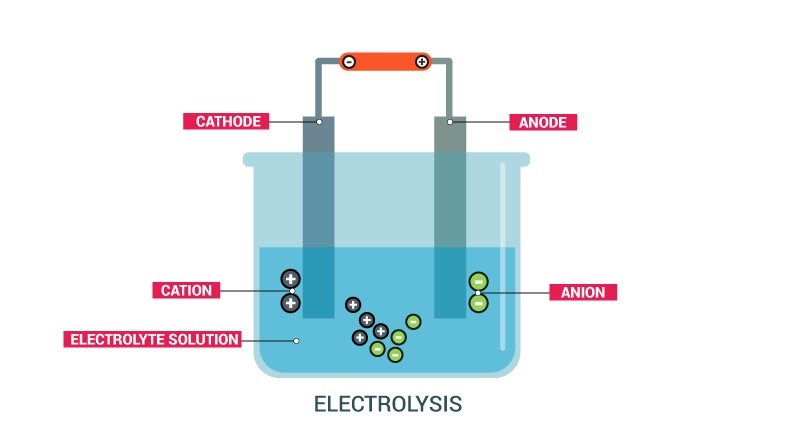
The machine that makes this happen is called an electrolyzer (or a stack, when referring to many cells together). You can think of it as a specialized chemical reactor.
At its core, every electrolyzer needs three main parts:
- Two Electrodes: These are conductive plates or surface made of metals or specialized materials called the anode (positive) and the cathode (negative).
- An Electrolyte: This is a substance, often liquid or a polymer membrane, that conducts ions (charged atoms) between the electrodes. It's the medium that allows the electrical current to complete the circuit through the water.
- A Power Source: This is what supplies the direct current (DC) electricity to the electrodes, providing the energy needed to break the strong bonds in the water molecules. If this power source comes from a renewable energy source, like solar or wind. The hydrogen produced is classified as Green Hydrogen, as there are zero greenhouse gas emissions, and therefore is environmentally friendly.
How the Water Splitting Works
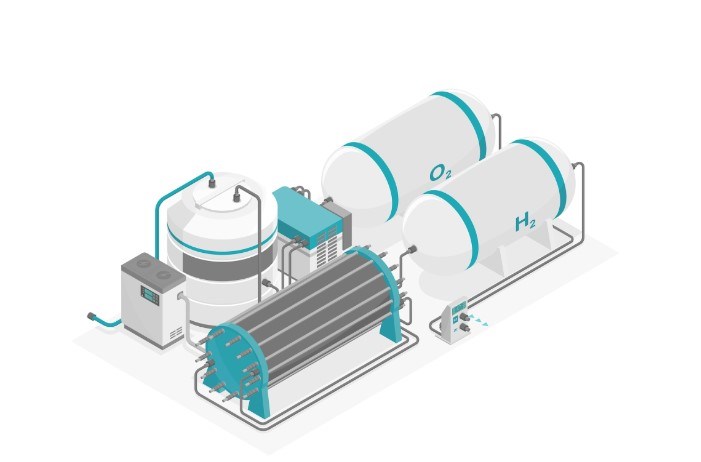
The process begins when electricity is applied to the two electrodes submerged in or touching the water/electrolyte. Let's look at the two main reactions that occur at each side:
The Anode (Positive Side): Oxygen Production
At the anode, the positive side, water molecules are attracted and give up electrons to the electrode. This is an oxidation reaction. When the electrons are stripped away, the water molecule breaks down. The products here are positively charged hydrogen ions (H+), oxygen gas (O2), and the electrons that power the circuit.
The Cathode (Negative Side): Hydrogen Collection
Meanwhile, the electrons that left the anode travel through the external circuit (the wiring) to the cathode, the negative side. This cathode is also attracting the positively charged hydrogen ions (H+) that were created at the anode.
When the H+ ions reach the cathode, they pick up the waiting electrons. This converts the ions back into neutral hydrogen atoms, which immediately pair up to form hydrogen gas (H2).
Three Main Types of Electrolysis
While the fundamental principle of splitting H20 is the same, there are three primary technologies used in modern industrial electrolysis, each suited for different applications and scales:
- Alkaline Electrolyzers (AEL): This is the oldest and most mature technology. It uses a liquid electrolyte, typically potassium hydroxide (KOH), and works at relatively high temperatures. AELs are durable, reliable, and generally the least expensive to manufacture, making them suitable for large, constant power sources.
- Proton Exchange Membrane Electrolyzers (PEM): These use a solid polymer membrane (the PEM) as the electrolyte. This design is compact, can operate at higher current densities, and, most importantly, can ramp up and down quickly. This makes PEM ideal for pairing with intermittent renewable energy sources, like solar or wind power, where the electricity supply fluctuates.
- Solid Oxide Electrolyzers (SOE): This is a newer, high-efficiency technology that operates at very high temperatures (around 700-850 ° C). The high heat means less electrical energy is needed to complete the water-splitting reaction. While complex to start up, SOEs are the most energy-efficient when running, offering significant long-term operational savings.
Stabilizing the Grid: A Storage Solution
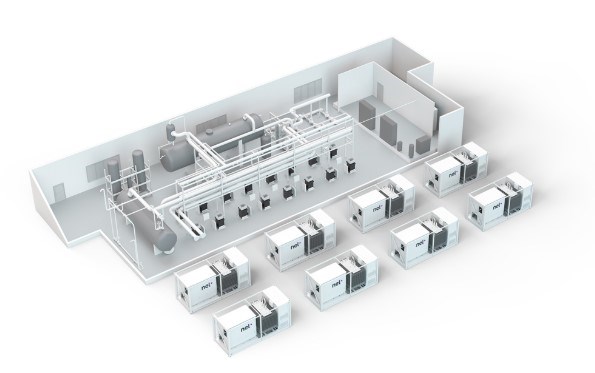
One of the greatest challenges facing renewable energy sources like wind and solar power is their intermittency. They only generate electricity when the wind blows or the sun shines. When production exceeds demand, the excess electricity must be either curtailed (wasted) or stored. This fluctuating power can destabilize the electrical grid.
This is where hydrogen electrolysis offers a powerful and flexible solution. Electrolyzers can act as large-scale energy sinks, effectively turning excess renewable electricity into a storable chemical fuel.
By consuming surplus energy and converting it into a dense, storable fuel, electrolysis acts as a vital buffer. Hydrogen is pulled from storage to electrify the grid during demand and supply fluctuations. This process not only solves the intermittency problem but also makes deep integration of renewables into the grid economically viable, moving us closer to a fully decarbonized energy system.
The Big Picture: Why Electrolysis Matters
Hydrogen electrolysis is crucial because it offers a direct path to decarbonization for sectors that are difficult to electrify or in combination with other green energy sources such as wind and solar to provide grid stabilization.
By generating hydrogen from renewable electricity, we create a storable, transportable energy carrier that can replace fossil fuels in these heavy-duty applications. It is a critical piece of the global effort to create a truly sustainable energy system, closing the loop on clean energy by turning intermittent renewable power into a fuel we can use anytime, anywhere.